
Accounting Content Marketing Checklist
Tax calendar | Compliance | Credentials | Buyer intent | Firm data | Expired figures | Conversion path | Formats | Measurement | FAQ
💡 Key Takeaways:
1) An accounting content marketing checklist has to cover demand timing, advertising compliance, author credentials, buyer-intent topics, and a traceable route from page to booked consultation.
2) Seasonal tax pages need publishing lead time, because a page usually requires two to four months of indexing and link acquisition before it holds a position worth having.
3) Expired dollar figures and missing bylines cost accounting firms more inquiries than ranking positions do, since both tell a reader that nobody maintains the site.
Every skipped check costs your firm billable revenue
Content Marketing House builds this checklist into every engagement, and our content marketing for accounting firms runs on the same workflow that has mapped 500+ keyword clusters and delivered 100+ content audits. The discovery call is free, onboarding costs nothing, and 90%+ of clients are still with us after twelve months.
Checkbox #1: Publish seasonal pages before the demand shows up
Seasonal accounting content has to be live and indexed months ahead of the spike it targets. Extension deadlines, quarterly estimate questions, and year-end planning queries all move on a schedule you can read a year in advance, and a page published during the spike rarely ranks in time to catch any of it.
Across our accounting engagements, new pages have needed somewhere between 9 and 15 weeks to settle into a stable position. Competitive filing-season terms take longer.

Read the calendar backwards
Start at each demand window and work back to a publish date. Check that your plan accounts for:
- Quarterly estimated payment deadlines and the questions that arrive before them
- The extension window and what clients ask during it
- Year-end planning topics, which surface earlier than most firms expect
- Entity formation queries, which cluster at the start of a calendar year
- State deadlines that sit apart from the federal ones
What late publishing costs you
A page published into peak demand competes against pages that have spent a full cycle collecting links and engagement signals. It arrives with none of that.
One tax advisory client insisted on publishing their extension guide about two weeks before the deadline, twice running. Both versions found their ranking position in the following off-season, when almost nobody was searching.
Sequencing belongs in the plan rather than the publishing calendar, which is why our accounting content marketing strategy work opens with a demand map instead of a topic list.
You are clear on this one when
Every seasonal page has a publish date at least a quarter ahead of its window, and a named person owns the refresh pass before the spike. Nothing seasonal sits in draft during the month it targets.
Worth knowing: the off-season is the cheapest time to publish in accounting, because competing firms go quiet from roughly February through April and again in September, which means the same page attracts a fraction of the competition for links and attention that it would face six weeks later, and our best-performing filing-season pages were all written during the quiet stretch when the client had nothing urgent to say.
Checkbox #2: Run every claim past Circular 230 and your state board
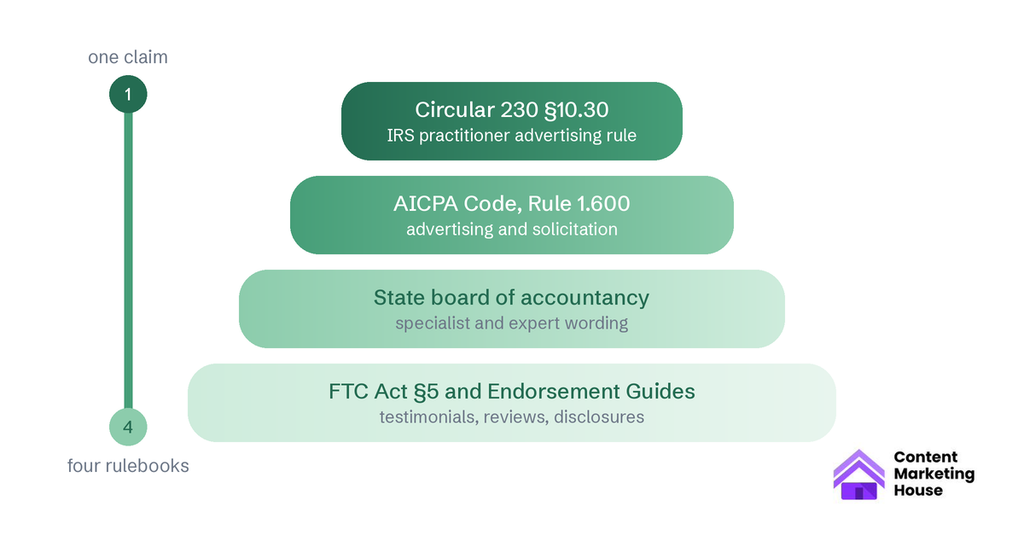
Advertising rules apply to accounting content the same way they apply to a billboard. Circular 230 bars practitioners from any public communication carrying a false, fraudulent, misleading, deceptive, or coercive claim, and the IRS lays out the practical version in its practitioner FAQ.
State boards stack their own rules on top. A handful restrict language that federal rules leave untouched, including how the words specialist and expert can be used.
Scan every draft for
Give each page a compliance pass before it reaches design. Look specifically for:
- Guaranteed refunds, savings amounts, or any outcome promise
- Wording that implies a special relationship with the IRS
- Fear-first headlines aimed at a reader’s financial anxiety
- Specialist or expert claims your board restricts
- Testimonials and case results published without required disclosures
Why the exposure lands on the firm
Sanctions follow the practitioner. A subcontracted freelancer working from a generic conversion playbook can write one sentence that costs a partner a censure, and the firm absorbs the consequence regardless of who typed it.
We keep a one-page banned-claims list attached to every brief for licensed clients. It has caught far more problems at draft stage than any review at publish stage ever did.
Some marketers argue that fear-framed headlines outperform everything else in tax content, which is frequently true and still beside the point once a state board reads the page. Firms in other licensed fields run the same sequence, which is why our law firm content marketing engagements put the compliance pass before design rather than after it.
Sign this off when
The banned-claims list exists in writing, travels with every brief and every vendor contract, and a named person approves copy before publication. Approval happens on the draft, not on the live page.
One caution: the banned-claims list has to travel with the work, because in our experience compliance failures almost never originate with the firm’s own writers, they come from a subcontracted freelancer or a lead-gen vendor working off a conversion playbook built for unregulated industries, and the firm carries the consequence whichever hands produced the sentence.
Checkbox #3: Does every money page name a credentialed author?
Financial guidance published without a name gives a reader nothing to weigh. A byline carrying a license, a firm role, and a review line does more for credibility than another 600 words of explanation.
Money topics face a higher trust bar from readers and from search quality systems, and accounting sits squarely in that category.
Check each page for
Open five published posts at random and confirm each one carries:
- A named author with the license stated correctly
- A bio describing a real specialization rather than a job title
- A reviewed-by line where a second professional signed off
- A visible last-reviewed date
- A contact route that reaches a person during busy season

What anonymity costs in trust
Anonymous pages underperform bylined ones across every accounting library we have measured. The gap widens on high-stakes topics like entity selection or responding to an IRS notice.
Adding credentials and reviewer lines to 23 existing posts for one advisory client lifted average time on page by about a third, with no other change to the pages.
Some practitioners argue the firm brand should carry authority instead of individual partners, since partners leave and pages outlive them. The concern is legitimate, and the workaround is a reviewer line tied to a role that survives turnover.
Regulated verticals share this requirement, and the same pattern carries into insurance content marketing work where licensing shapes every page.
Consider it handled when
No page offering financial guidance publishes without an author, a credential, and a review line. Bios link to a staffed contact route.
Checkbox #4: Trade definition posts for service-plus-situation pages
Definition queries pull students, job seekers, competitors, and readers who will never hire anyone. A page ranking for “what is accrual accounting” delivers volume and almost no inquiries, while “outsourced controller for construction companies” delivers a fraction of the sessions and a buyer with a budget.

Audit your topic list for
Map every planned and published page against buying stage. Flag:
- Textbook definitions with no commercial signal behind them
- Service-plus-industry combinations you serve but never wrote about
- Problem-first queries: IRS notice, missed deadline, failed reconciliation
- Comparison topics such as in-house bookkeeper versus outsourced team
- State pages covering the jurisdictions where your clients concentrate
Where the traffic leaks
One firm we audited had grown to roughly 14,000 monthly organic sessions and was booking fewer than two consultations a month from content. Every one of their top ten pages was a textbook definition.
Reporting made it worse, because the traffic curve looked like progress for four straight quarters while the pipeline stayed flat.
Cap the learning tier at about a quarter of the calendar, since it still supports topical coverage and internal linking. Our accounting content marketing guide walks through the stage mapping in detail.
This one closes when
Every page on the calendar carries a stage label, and the majority of production capacity points at comparison and hiring intent.
Field note: the highest-value accounting page we have ever produced targeted a keyword with a reported search volume of 30 a month, held position 4 for two years, and generated 19 booked consultations in that time, which is a return no definition page in the same library came close to matching despite pulling forty times the sessions.
Checkbox #5: Publish the numbers only your firm holds
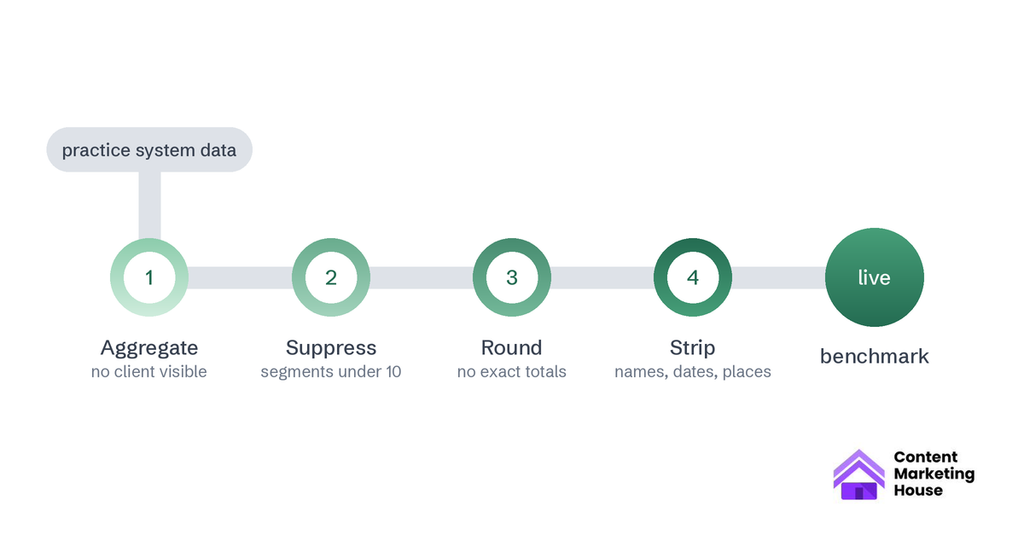
Accounting firms sit on benchmark data nobody else can publish. Average days sales outstanding across 200 client businesses, the share of clients who missed an estimated payment, the most common bookkeeping error by industry, all of it lives in the practice management system already.
Original data is the one accounting asset that earns links without outreach.
Pull these numbers first
Ask what you could publish this quarter without touching client confidentiality:
- Aggregate figures that cannot be traced to an individual client
- Shifts you have watched across several filing cycles
- Industry splits where your client base runs deep
- Error and exception rates from your own review process
- Benchmarks clients already ask you for in meetings
Why original data travels
A benchmark report published by one 14-person firm we worked with picked up 31 referring domains in its first two quarters with no outreach at all. Two of those links came from trade publications that had never mentioned the firm.
The compounding matters more than the launch. Republished each cycle, the same report becomes a citation habit for journalists and trade editors, and the second edition took roughly a third of the production hours the first one did.
Run the anonymization and engagement letter review before anyone drafts, since retrofitting confidentiality onto a finished report usually means rebuilding it. The same benchmark play carries into manufacturing content marketing, where operators want peer numbers they cannot find anywhere else.
Ready to publish when
One dataset per year is scoped, cleared, and scheduled, with a named owner for the refresh.
Checkbox #6: When did anyone last verify the figures on your site?
Expired dollar amounts are the quietest credibility problem in accounting content. Contribution limits, deduction amounts, mileage rates, and reporting thresholds each move on their own schedule, and the IRS has issued mid-year adjustments to the standard mileage rate more than once, which means an annual sweep occasionally arrives too late.
Sweep the library for
Run a site-wide search rather than trusting memory. Hunt for:
- Hard-coded dollar figures and percentage rates in body copy
- Deadline dates written into sentences instead of pulled from a source
- Screenshots of forms and portals that have since been redesigned
- Links pointing to superseded guidance
- References to relief programs that have ended

The credibility cost of one stale number
An outdated figure costs rankings slowly and trust instantly. The prospect who already knows the current number spots the old one and closes the tab.
During one audit we counted 61 outdated figures across 84 pages. Their busiest post still quoted a mileage rate that was three years old.
Content inventory tooling earns its keep here, and a simple last-reviewed field has saved us more refresh time than any writing assistant. Our rundown of accounting content marketing tools covers what actually holds up at library scale.
Call it current when
Every number on the site appears in one tracked sheet with its source URL and the pages it touches. One person owns the sweep, and refreshed pages get their modified date updated.
Checkbox #7: Give every page one route to a booked consultation
A page with no next step ends the relationship at the last paragraph. Each published piece needs a single obvious route forward, matched to how ready that particular reader is.
Inspect each page for
Walk the path yourself, from search result to confirmation email. Check for:
- One primary call to action rather than a stack of competing ones
- An offer matched to intent, such as a checklist early and a consultation late
- A booking route showing real availability
- Form fields you genuinely use during intake
- A confirmation message that states what happens next and when
Where the handoff usually breaks
Most firms lose prospects between the page and the calendar. Contact forms route to a shared inbox nobody owns during filing season, and the reply lands after the prospect has already hired someone else.
Across our client work, replacing a generic contact form with a booking link showing open slots has moved inquiry-to-call conversion in every accounting engagement we have run it in, once from about 11% to 26% inside a quarter. Budget shapes how far you can take this, and our breakdown of accounting content marketing cost covers what a conversion-ready page takes to produce.
Mark this complete when
Every published page has one named next step, and someone owns response time during the busiest eight weeks of the year.
Checkbox #8: Cut one topic into more than one format
Content marketing spans video, audio, visuals, and interactive tools, and accounting buyers use all of them. A single recorded webinar yields a written guide, a set of short clips, a data visual, and an email sequence.
Producing one asset per topic and moving on is the biggest waste we see in accounting content libraries.

Inventory what you already own
Before commissioning anything new, list the material sitting unused:
- Recorded client webinars and internal training sessions
- Partner presentations trapped in slide decks
- Spreadsheet models that could become calculators
- Frequently sent client emails that answer one question well
- Podcast or panel appearances nobody transcribed
Why a single format caps your reach
Written content reaches the reader who searches. It misses the owner who would rather watch six minutes of a partner explaining entity choice, and the operator who listens on a commute.
Interactive assets compound hardest. An entity-comparison calculator we built for one accounting client kept earning links for three years after launch, well after the posts published that same quarter had flattened out.
The repurposing sequence is the same one we run for b2b saas content marketing clients, adjusted for a longer approval chain and tighter claim review.
Consider it wrapped when
Each core topic ships in at least two formats, and repurposing sits in the production brief rather than in someone’s good intentions.
Keep in mind: the cheapest video an accounting firm can produce is a partner answering one client question into a laptop camera for four minutes, unscripted and unedited beyond a trim, and those clips have consistently outperformed the polished animated explainers we have made for the same firms at roughly fifteen times the cost, which says more about what accounting buyers want to see than any format study will.
Checkbox #9: What should an accounting firm actually measure?
Measure inquiries, booked consultations, close rate by entry topic, and the fee level of clients who arrived through content. Session counts say nothing about whether the library is producing clients, and in accounting the two curves separate quickly because the highest-volume topics are the least commercial.
Track these instead
Rebuild the monthly report around outcomes:
- Consultations booked, attributed to an entry page
- Close rate segmented by the topic that brought them in
- Average fee of content-sourced clients against referral-sourced ones
- Elapsed time from first visit to first inquiry
- Pages that appear in the path but never convert directly
Why session counts mislead partners
A traffic report gives a managing partner no way to judge whether content deserves next year’s budget. Attribution in accounting is slow, since a prospect who reads a year-end planning post might not call until the following spring.
A solo practitioner can run this with a booking tool and a spreadsheet listing where each new client first landed. A multi-partner firm needs the attribution window set to at least 180 days, otherwise the reporting credits the last blog post read and misses the guide that started the relationship.
Reporting is fixed when
The monthly report leads with booked consultations and closed fees, and traffic sits below them as context rather than as the headline.
Accounting content marketing checklist FAQ
Disclaimer: This post is for general informational purposes only and does not constitute tax, legal, accounting, or financial advice. Figures, thresholds, and regulatory requirements change and should be verified with a qualified professional and against primary sources before you act on them. Content Marketing House accepts no liability for decisions made on the basis of this content.